
Discover why AI startup studio model boosts success 30% over solo ventures. Get speed to market, co-founding, and funding fast.
Date
05/05/2026
Author
James Reed
THE HONEST TRUTH ABOUT BUILDING AN AI STARTUP SOLO IN 2026

An AI startup studio is a company that partners with founders to co-build, fund, and launch AI startups from the ground up — providing capital, a technical team, and go-to-market support from day one, in exchange for equity.
Here's what that means in practice:
What You Get | What the Studio Gets |
|---|---|
Capital ($250K–$500K on average) | Equity stake (typically 20–40%) |
Fractional co-founders (product, engineering, GTM) | Long-term upside in the company |
Shared infrastructure (data pipelines, DevSecOps) | Alignment through skin in the game |
Investor network and follow-on fundraising support | Portfolio diversification |
Validated playbooks from prior builds | Early access to emerging AI sectors |
How it differs from alternatives:
Accelerators give you mentorship and small checks — you still build everything yourself
VCs give you capital — but no operational help
AI startup studios give you a full co-building team from zero
Building an AI startup alone is brutally hard. Most technical founders have the vision and the code — but not the co-founder, the early capital, the GTM motion, or the operational depth to go from idea to Series A without burning out or running out of runway.
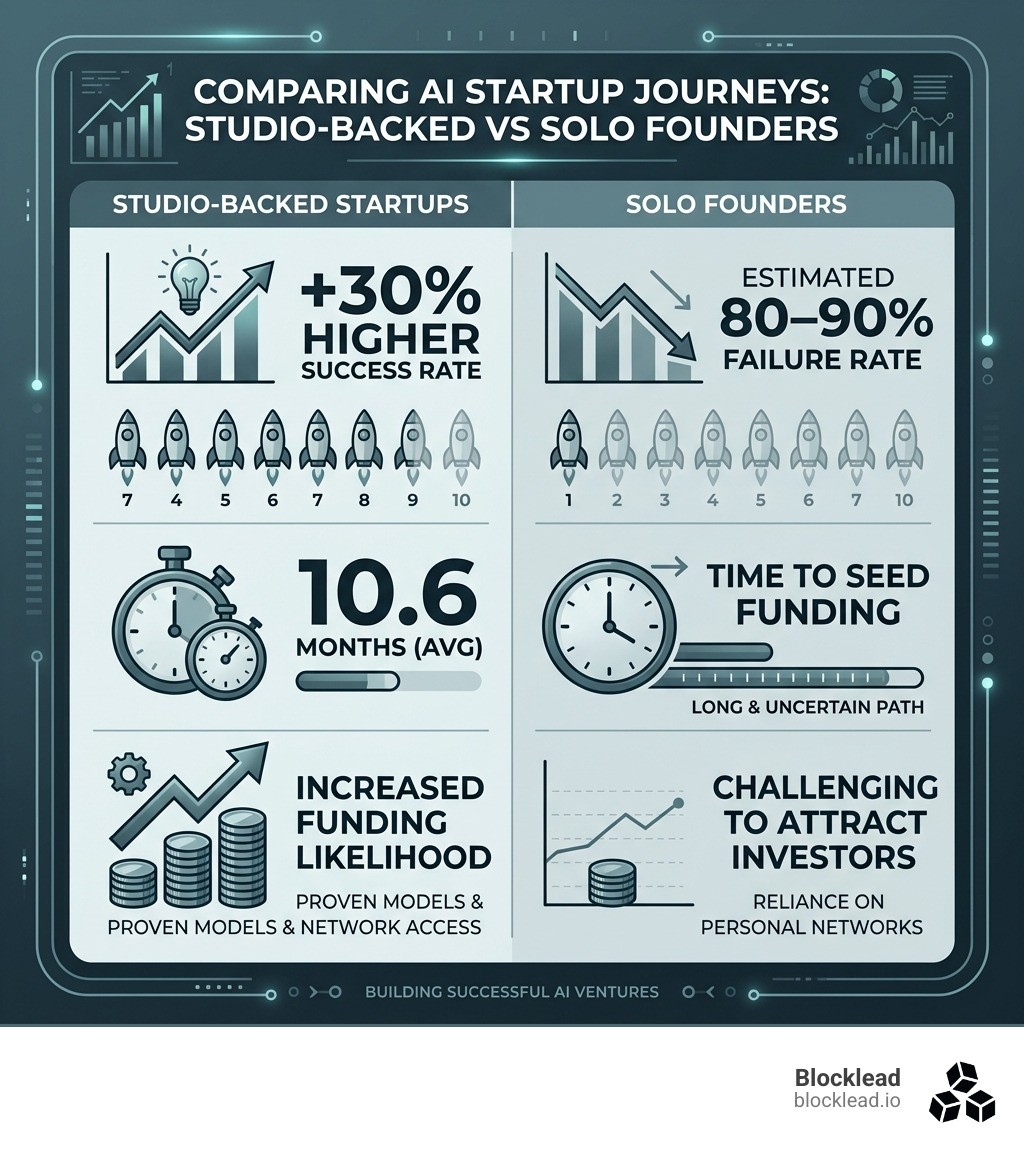
The data backs this up. Independent startups fail at a rate of 80–90%. Studio-backed startups, by contrast, have a 30% higher success rate — and they reach their seed round in an average of just 10.6 months, less than a third of the time it takes solo founders.
That gap isn't luck. It's infrastructure, experience, and aligned incentives working together from day one.
DEFINING THE AI STARTUP STUDIO MODEL IN 2026
In 2026, the tech landscape has moved beyond "wrapper" startups. We are now in the era of deep integration, where the ai startup studio acts as a specialized factory for high-performance intelligence. Unlike traditional business models, a studio doesn't just wait for you to pitch; we often generate the initial hypothesis ourselves or work with you to refine a raw concept into a market-ready venture.
This is a "parallel entrepreneurship" model. We aren't just an investor sitting on the sidelines; we are in the trenches with you. To understand how this works at a granular level, you can explore our Inside the AI Venture Studio Playbook, which breaks down our internal mechanics.
The shift toward this model is driven by the complexity of the modern AI stack. Building a sustainable company now requires more than just a good prompt. It requires a deep understanding of The Rise of AI Venture Studios: A New Co-Funding Model, where capital and labor are fused from the start.
Distinguishing Studios from Accelerators and VCs
The most common question we get is: "Isn't this just an accelerator?" The answer is a firm no.
An accelerator takes an existing team and gives them a "booster shot" of mentorship over 12 weeks. A venture capital (VC) firm gives you a check and sees you at quarterly board meetings. In contrast, an ai startup studio provides:
Day-Zero Support: We help incorporate the company, hire the first employees, and set up the cap table.
Operational Involvement: Our designers, engineers, and marketers are your team until you hire your own.
Fractional Co-founders: You get a world-class CTO or GTM lead on a fractional basis to ensure you don't make rookie mistakes.
Equity Alignment: Because we invest our own resources and team hours, we are just as incentivized as you are to reach a successful exit.
The Evolution of AI-Native Venture Building
By 2026, the "AI-native" approach has matured. We are no longer just putting "AI" in the name; we are building startups where AI is the core engine of value. This involves:
Agentic Systems: Moving from passive tools to autonomous agents that can execute complex workflows.
Foundation Models: Leveraging and fine-tuning the latest LLMs and multi-modal models to create proprietary value.
Automated Market Validation: Using AI-driven tools to scan the horizon for disruptive opportunities and test demand before a single line of production code is written.
Scalable Data Moats: Ensuring that every interaction with the product makes the underlying model smarter and more defensible.

WHY STUDIO-BACKED STARTUPS OUTPERFORM SOLO FOUNDERS
The numbers tell a compelling story. If you go it alone, the odds are stacked against you. But when you partner with a studio, you are essentially "pre-validating" your success. Research shows that studio startups are 40% more likely to raise follow-on funding from Seed to Series A compared to their solo counterparts.
Feature | AI Startup Studio | Traditional Accelerator | Traditional VC |
|---|---|---|---|
Involvement | Co-founder / Deeply Operational | Mentorship / Educational | Financial / Strategic |
Team Support | Full engineering/GTM squad provided | Solo / Existing team only | No team support |
Success Rate | ~30% higher than solo | Variable | Variable |
Time to Seed | ~10.6 months | ~18-24 months | ~24+ months |
We've seen that the "co-funding" aspect is a major catalyst. You can read more about How Co-Funding Accelerates AI Startup Success to see how reducing the initial financial friction allows founders to focus entirely on the product.
Speed to Market and Funding Likelihood
In the AI world, speed is the only real moat. If you spend six months just trying to find a co-founder and another six months raising a pre-seed round, the market will have moved on.
An ai startup studio compresses this timeline. Because we provide the initial $250K–$500K and a ready-to-go technical team, you can go from "napkin sketch" to a market-tested MVP in weeks, not months. This rapid validation is why studio companies are so much more attractive to Tier-1 VCs when it's time for the Series A; the technical stack is already de-risked, and the unit economics are proven.
Shared Resources in an AI Startup Studio
One of the biggest hurdles for solo AI founders is the "coordination tax"—the 80% of your time and budget spent on things that aren't the product (HR, legal, setting up servers, hiring).
In our studio, we provide a "shared services backbone." This includes:
GPU Clusters: Immediate access to the compute power needed for training and inference.
Data Pipelines: Pre-built frameworks for data ingestion and cleaning that can be reused across different ventures.
Shared DevSecOps: Robust, scalable, and secure infrastructure from day one, so you don't have to rebuild your security protocols from scratch.
This infrastructure is why we believe Why AI Infra Startups Are the Most Important Bets in Tech Right Now—the foundational layer is what enables the application layer to scale at 30x speed.
THE OPERATING PLAYBOOK: FROM IDEATION TO SCALE
How do we actually build these companies? We follow a rigorous, stage-gated process designed to kill weak ideas early and pour gasoline on the winners. This is the heart of the ai startup studio model.
The "Create" and "Forge" Engines
Most successful studios operate with two primary "engines":
The Create Engine (Discovery): This is a 4–6 week sprint where we frame the problem. We use AI tools for horizon scanning, conduct venture design sprints, and validate the concept via rapid prototyping. We ask: "Is this a real problem, and can AI solve it 10x better than existing solutions?"
The Forge Engine (Build): Once a concept is validated, we move into the forge. This is where a dedicated squad builds the MVP (usually in under 12 weeks). We focus on unit economics and "private beta" launches to get real user feedback as quickly as possible.
This process is specifically tailored for Meet the Technical Founders Building the Future of Agentic AI, who need a structured environment to turn their technical breakthroughs into viable businesses.
Is an AI Startup Studio Right for Your Idea?
Not every idea is a fit for a studio. We look for high-leverage opportunities where our technical and operational resources can provide a structural advantage. Common focus areas include:
B2B SaaS: Automating complex enterprise workflows.
Healthcare AI: Using agentic systems for diagnostics or administrative efficiency.
Fintech: AI-driven trading, fraud detection, or personalized banking.
Developer Tooling: Building the infrastructure that other AI developers will use.
If you are building in these spaces, our The No-Nonsense Guide to Building Applied AI Systems provides a roadmap for how we think about product architecture and market fit.
EVALUATING EQUITY, FUNDING, AND FOUNDER PROFILES
Partnering with an ai startup studio is a significant commitment. You are essentially bringing on a "super co-founder." Because of this, the equity and funding arrangements are different than a traditional investment.
Typical Funding and Equity Arrangements
While every studio is different, the industry standard in 2026 has settled into a predictable range:
Capital: $250K to $500K in initial investment at company formation.
Equity: The studio typically retains 20% to 40% equity. This reflects the "sweat equity" of the team provided and the de-risking of the venture.
Spin-out Process: Once the company hits specific milestones (like $1M ARR or a successful Seed round), it "spins out" as an independent entity with its own full-time team.
Follow-on Capital: Most studios, including us, syndicate follow-on rounds or have a network of partner VCs ready to lead the next stage.
The ideal founder for this model is someone with deep domain expertise. We love working with technical leaders who have a "chip on their shoulder" and the humility to let us handle the operational bottlenecks. If you're struggling to find that perfect partner, check out our guide on How to find a Co-Founder for Your AI Startup Without Losing Your Mind.
Potential Drawbacks and Risk Mitigation
We want to be transparent: the studio model isn't for everyone.
Equity Cost: You give up more equity early on than you would in a solo bootstrap scenario. However, 60% of a billion-dollar company is worth significantly more than 100% of a failed one.
Control Dynamics: You are co-building. This means you have to be open to feedback and collaborative decision-making.
Cultural Alignment: Since the studio team is your team for the first 6-12 months, cultural fit is paramount.
We mitigate these risks by agreeing on terms upfront and ensuring our incentives are perfectly aligned with yours. We only win when you win.
FREQUENTLY ASKED QUESTIONS ABOUT AI STARTUP STUDIOS
How does an AI startup studio differ from a traditional incubator?
An incubator provides a space to work and some light mentorship, often for a fee or a very small equity stake. An ai startup studio is much more hands-on; we are your co-founders. We write code, design the UI, and run your sales calls. We aren't just incubating your idea; we are building the company alongside you.
What is the typical success rate for startups launched from a studio?
Data shows that startups launched from studios have a 30% higher success rate than solo startups. Furthermore, about 63% of studio-backed AI companies raise follow-on capital within 12 months of formation, compared to a much lower percentage for independent startups.
Do I need a finished MVP to apply to an AI venture studio?
No. In fact, many of the best studio-backed companies start at the "concept" or "problem" stage. We prefer to be involved early so we can help architect the MVP using our shared infrastructure and agentic playbooks. If you have deep domain expertise and a validated problem, that is often enough to start the conversation.
CONCLUSION
The era of the "lone wolf" founder is fading in the face of AI's complexity. To win in 2026, you need more than just a good idea; you need a launch weapon.
At Blocklead, we specialize in co-founding AI startups from zero. We focus on the high-impact sectors that define the future: agentic systems, applied AI, infrastructure, and developer tooling. As a practitioner-led team, we don't just give you advice—we give you a co-founder, capital, operators, and a global network that spans San Francisco, Europe, and Latin America.
If you are a technical founder ready to move at 30x speed and bypass the "coordination tax" that kills most startups, let's talk. Build your future with Blocklead and let's turn your vision into the next industry-defining AI venture.