
Guides
Date
Key Insight | Explanation |
|---|---|
AI accelerators differ significantly in depth | Some offer capital and mentorship only; others co-found alongside you and write production code. |
Practitioner involvement matters most | Programs backed by engineers with production AI experience deliver more actionable support than advisor-only models. |
Accelerator vs. venture studio distinction | Accelerators run cohort programs; venture studios co-found from day zero with embedded operational support. |
Cloud credits are a real differentiator | Programs like Google Cloud and AWS offer hundreds of thousands in compute credits, which directly reduce burn rate. |
Fit depends on your stage and domain | Founders building agentic systems or AI infrastructure need domain-specific support, not generalist batch programs. |
Global presence reduces founder friction | Time-zone-aligned support and local network introductions move deals faster than remote-only mentorship. |
Table of Contents
What Is an AI Startup Accelerator?
Top AI Startup Accelerator Programs in 2026
Accelerator vs. Venture Studio: Which Model Fits Your AI Company?
How to Choose the Right AI Startup Accelerator
What to Expect From a Strong AI Accelerator Program
Sources & References
Frequently Asked Questions
Choosing the right AI startup accelerator is one of the highest-leverage decisions a technical founder makes in the first 12 months. The wrong program wastes runway. The right one compresses years of learning into months, connects you with practitioners who've shipped real systems, and opens doors that cold outreach never will. As of 2026, the landscape has matured considerably: programs now range from eight-week cloud credit bundles to deep co-founding partnerships where senior engineers sit alongside your team and write production code. This guide breaks down the top options, explains what actually separates them, and gives you a decision framework grounded in what founders building agentic systems, applied AI, and AI infrastructure actually need.
What Is an AI Startup Accelerator?
An AI startup accelerator is a structured program that provides early-stage AI companies with capital, mentorship, technical resources, and network access in exchange for equity or a fee, typically over a fixed time period of six to sixteen weeks.
The term gets used loosely. Some programs are essentially cloud credit bundles with a Slack community attached. Others embed experienced operators directly into your founding team. Understanding the difference matters before you apply anywhere.
Core Components of a Legitimate AI Accelerator
Most credible programs share a baseline set of offerings:
Capital: Pre-seed or seed funding, ranging from $20,000 to $500,000 depending on the program
Mentorship: Access to advisors, domain experts, or practitioners with relevant AI experience
Technical resources: Cloud compute credits, API access, or infrastructure support (Google Cloud's AI startup program offers up to $350,000 in credits [1])
Network access: Introductions to investors, potential customers, and hiring pipelines
Demo day or investor showcase: A structured pitch event at program end
What Separates AI-Specific Programs From General Accelerators
General accelerators like Y Combinator accept companies across every sector. AI-specific programs are built around the distinct needs of founders working with machine learning, large language models (LLMs, or foundation models trained on massive datasets), agentic systems (AI that autonomously plans and executes multi-step tasks), and AI infrastructure (the tooling, compute, and data pipelines that make AI systems run in production).
Industry analysts note that AI-specific programs tend to offer deeper technical mentorship and more relevant investor networks. According to StartupBlink's 2026 analysis of top AI accelerators, the number of dedicated AI startup programs has grown by over 40% since 2023, reflecting the surge in founders building on frontier models [2].
One common mistake founders make is applying to any accelerator with "AI" in the name without checking whether the mentors have actually shipped AI products in production. A mentor who advised a SaaS company five years ago isn't equipped to help you debug your retrieval-augmented generation (RAG) pipeline or optimize inference costs at scale.
Pro Tip: Before applying to any AI accelerator, ask directly: "Can you name a mentor who has shipped an agentic system or LLM-powered product to paying customers in the last 18 months?" If the answer is vague, that tells you everything about the program's actual depth.
Top AI Startup Accelerator Programs in 2026
The best AI startup accelerator programs in 2026 combine meaningful capital, hands-on technical support, and access to investor networks that are actively deploying into AI.
Here are the standout programs worth evaluating, organized by their primary value proposition:
Programs Backed by Major Tech Infrastructure
Google for Startups Accelerator — A three-month program giving early-stage startups direct access to Google's products, engineers, and best practices [3]. Strong for founders building on Google Cloud or needing ML infrastructure support. The program is selective and cohort-based, which limits customization but maximizes peer learning.
Google Cloud AI Startup Program — Offers up to $350,000 in Cloud credits alongside dedicated enablement support and access to Google's open AI ecosystem [1]. Best for founders who need compute without burning early capital. Less hands-on than a co-founding model, but the credit value is real and significant.
AWS Generative AI Accelerator — An eight-week hybrid program specifically for generative and agentic AI startups [4]. AWS provides compute credits, go-to-market resources, and access to its partner network. The program's focus on agentic AI makes it more relevant than general cloud startup programs for founders building autonomous systems.
Together AI Startup Accelerator — Provides compute credits, engineering support, and go-to-market resources for startups building on the AI-native cloud [5]. Particularly strong for founders who need inference infrastructure and don't want to manage their own GPU clusters.
OpenAI for Startups — Gives founders tools, API credits, and community access to build on OpenAI's model stack [6]. The program has expanded significantly as of 2026, with tiered support for early-stage companies and more established startups alike.
Research-Backed and Institutional Programs
AI2 Incubator — Born from the Allen Institute for AI, this program supports top-tier founders building AI-first startups with deep technical expertise and research-grade mentorship [7]. Best for founders whose work sits at the intersection of applied research and commercial product. The bar for entry is high, but the technical credibility is unmatched.
Founder Institute — Positions itself as the world's largest AI-native company builder, helping aspiring and first-time founders go from zero to funded using AI tools and a proven methodology [8]. Strong global network and structured curriculum, though the program is broader than pure AI infrastructure or agentic systems.
Meta x HEC Paris AI Startup Accelerator — A six-month program enabling founders to test, iterate, and scale using open-source AI in real-world conditions [9]. Particularly relevant for European founders or those building with open-source model stacks.
Technovation AI Ventures Accelerator — A free program fast-tracking teams from idea to investor-ready AI venture, with up to $10,000 in funding [10]. Designed for underrepresented founders and younger entrepreneurs entering the AI space.
gBETA at WCTC Applied AI Lab — A seven-week accelerator for early-stage companies ready to scale their AI startup, offering intensive support in a focused format [11].
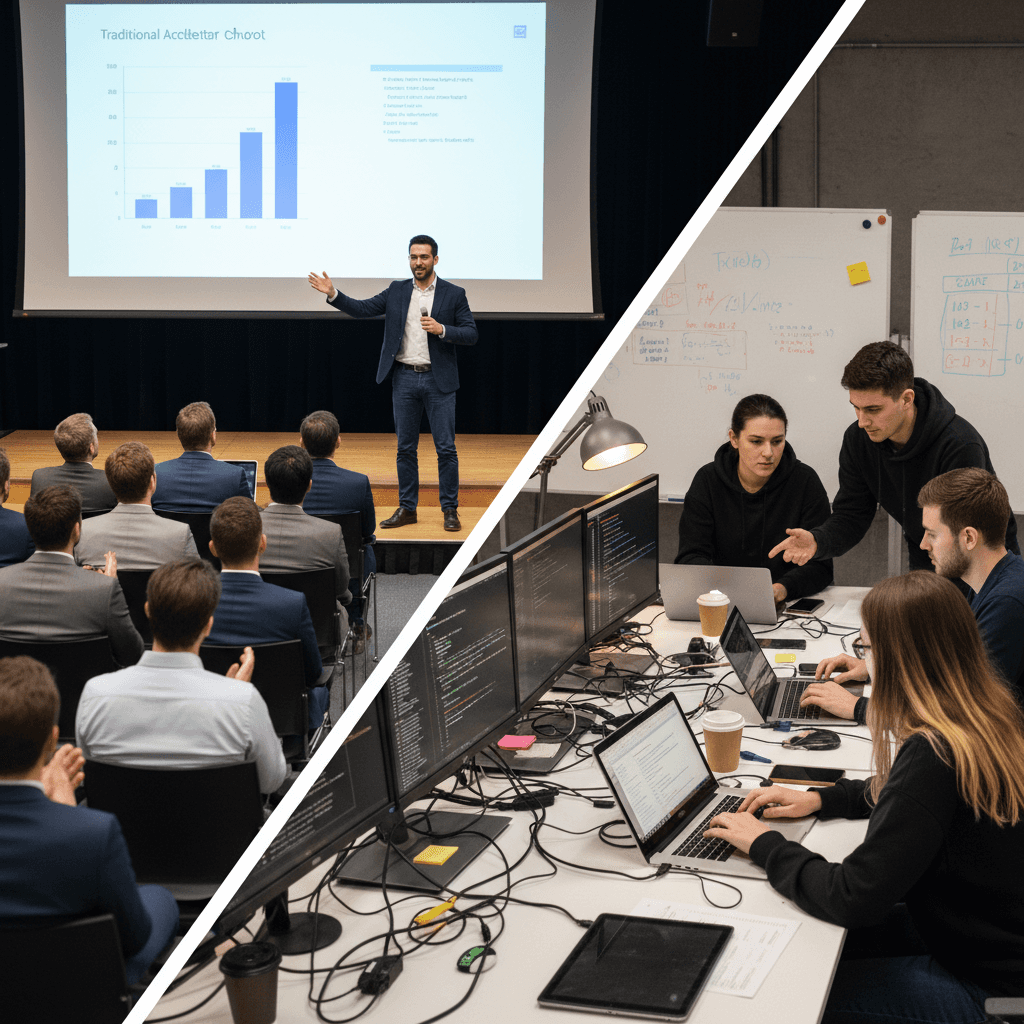
Accelerator vs. Venture Studio: Which Model Fits Your AI Company?
An accelerator runs cohort-based programs with fixed timelines; a venture studio co-founds companies from inception with embedded operators, capital, and ongoing hands-on involvement. These are fundamentally different engagement models.
Most founders conflate the two. The distinction matters because the support you need at day zero is very different from what a 12-week cohort program is designed to deliver.
Side-by-Side Comparison
Dimension | AI Startup Accelerator | AI Venture Studio |
|---|---|---|
Engagement start | After prototype or MVP exists | Day zero, before company is formed |
Program duration | 6–16 weeks (fixed cohort) | Ongoing, aligned with company lifecycle |
Technical support | Mentorship and office hours | Senior engineers writing production code |
Capital model | Fixed check at program entry | Capital + equity co-founding partnership |
Customization | Low (cohort curriculum) | High (tailored to your specific domain) |
Operational support | Limited (introductions, workshops) | Hiring, customer acquisition, GTM strategy |
Best for | Founders with working product seeking validation and investor access | Technical founders building from scratch who need a co-founding partner |
When a Venture Studio Outperforms an Accelerator
If you're a technical founder with deep AI expertise but no operational playbook, a cohort-based accelerator may not move fast enough. You need someone who can help you make architectural decisions, hire your first ML engineer, and close your first enterprise customer, all at the same time.
At Blocklead, we've found that founders building in agentic systems or AI infrastructure often arrive at accelerator demo day with a polished pitch but an unvalidated product. The co-founding model addresses this by embedding practitioners from day zero, so the product and the business develop together rather than sequentially.
Pro Tip: If you're pre-product and pre-revenue, a venture studio co-founding model will almost always outperform a batch accelerator program. Accelerators are optimized for founders who already have something to accelerate.
How to Choose the Right AI Startup Accelerator
Choosing the right AI startup accelerator requires evaluating five factors: your current stage, the program's technical depth, the quality of its network, its domain fit with your specific AI vertical, and the terms it requires in exchange for support.
Most founders apply to programs based on brand recognition. That's a mistake. A well-known name doesn't guarantee the mentors have shipped agentic systems or understand inference cost optimization.
A Five-Factor Decision Framework
Stage alignment: Are you pre-product, pre-revenue, or post-traction? Accelerators are generally designed for founders with at least a working prototype. If you're at day zero, a venture studio or co-founding partnership is a better fit.
Technical depth of mentors: Ask for a list of mentors and verify their production AI credentials. Have they shipped LLM-powered products, built data pipelines at scale, or deployed agentic workflows in enterprise environments? Advisory experience alone isn't enough.
Domain specificity: A founder building AI infrastructure tooling has very different needs from one building a consumer-facing applied AI product. Look for programs with mentors and portfolio companies in your specific domain.
Network quality: The investor network matters more than the program curriculum for most founders. Research which investors have funded companies that came through the program in the last 24 months.
Terms and equity: Standard accelerator equity ranges from 5% to 10%. Some programs take more. Understand what you're giving up and whether the support justifies it. Cloud credits worth $350,000 have real value; a weekly Zoom call with a generalist advisor does not.
Red Flags to Watch For
Mentors listed without verifiable AI production experience
No portfolio companies you can speak with directly
Equity asks above 10% for cohort-based programs
Vague promises about "investor introductions" without named investors
Programs that haven't updated their curriculum to reflect post-2024 AI developments (agentic workflows, multimodal systems, inference cost management)
Research from OpenVC's 2026 directory of AI accelerators shows that the most successful AI startup programs share one characteristic: their mentors have direct experience with the specific failure modes founders will encounter, not just general startup advice [12].
What to Expect From a Strong AI Accelerator Program
A strong it delivers four concrete outcomes: a validated product direction, a warm investor pipeline, measurable technical progress, and at least one paying customer or signed LOI by program end.
These aren't aspirational goals. They're the baseline a well-run program should hold itself accountable to. If a program can't point to these outcomes across its recent cohorts, that's a signal worth taking seriously.
The Typical Program Arc
Weeks 1-2 (Diagnosis): Identify your biggest technical and commercial risks. Good programs do this honestly, even if it means telling you your current approach won't work.
Weeks 3-6 (Build and validate): Rapid iteration on product with access to mentors, compute resources, and potential design partners. This is where cloud credits and technical mentorship have the most impact.
Weeks 7-10 (Customer development): Structured customer discovery and early sales conversations, often facilitated by the program's network.
Weeks 11-12 (Investor preparation): Demo day preparation, pitch refinement, and warm introductions to investors who are actively writing checks into AI companies.
What the Best Programs Do Differently
The programs that produce the strongest outcomes share a few practices that separate them from the median:
Honest feedback over cheerleading: The best mentors tell you when your product direction is wrong, not just how to pitch it better.
Practitioner-led sessions: Workshops run by engineers who've shipped production AI, not consultants who've advised AI companies.
Domain-specific investor networks: Introductions to investors who have a genuine thesis in your specific AI vertical, not just a general interest in "tech."
Operational playbooks: Documented processes for AI-specific challenges like data strategy, model iteration cycles, and unit economics for inference-heavy products.
Our team at Blocklead recommends that founders treat the first two weeks of any accelerator program as a diagnostic period. Use that time to pressure-test your assumptions with every mentor you can access, not to polish your pitch deck.
Pro Tip: Request introductions to 3-5 alumni from recent cohorts before you accept any accelerator offer. Ask them specifically: "Did the program help you ship faster or raise capital faster?" Alumni answers are more reliable than any program marketing.
Industry analysts at StartupBlink note that the highest-performing AI accelerator cohorts in 2024-2026 consistently share one trait: founders entered with a clear technical hypothesis and used the program to validate or invalidate it quickly, rather than treating the program as a networking event [2].

Sources & References
StartupBlink, "Top 20 AI Accelerators, Incubators & Startup Programs," 2026
Google for Startups, "Google for Startups Accelerator," 2026
OpenAI, "OpenAI for Startups," 2026
Founder Institute, "World's Largest AI-Native Company Builder," 2026
HEC Paris, "AI Startup Accelerator | Meta X HEC Paris," 2026
Waukesha County Technical College, "AI Startup Accelerator Program," 2026
OpenVC, "Top AI Accelerators & Incubators for Startups," 2026
Frequently Asked Questions
1. What is an AI startup accelerator and how does it work?
An this method is a fixed-duration program (typically 6-16 weeks) that provides early-stage AI companies with capital, mentorship, technical resources, and investor access in exchange for equity. Founders join a cohort, work through a structured curriculum, and pitch to investors at a demo day at program end. The best programs also offer cloud compute credits, domain-specific technical mentorship, and warm introductions to active AI investors. Results vary significantly based on program quality and founder preparation.
2. How is an AI startup accelerator different from a venture studio?
An this strategy runs cohort-based programs with fixed timelines and typically engages founders who already have a prototype or MVP. A venture studio co-founds companies from day zero, with embedded operators, capital, and ongoing hands-on involvement that extends well beyond a 12-week program. Venture studios like Blocklead partner with technical founders before the company is even incorporated, providing co-founding support, production-level technical guidance, and operational help with hiring and customer acquisition. The two models serve different stages and founder needs.
3. How much equity does an AI startup accelerator typically take?
Most this approach programs take between 5% and 10% equity in exchange for their program benefits, capital, and support. Some programs at the top of the market (like Y Combinator) have standardized their terms at around 7%. Cloud-credit-focused programs from major tech companies (Google Cloud, AWS) may take little to no equity, as their primary goal is ecosystem adoption rather than financial return. Always read the full term sheet and compare the value of what you're receiving against the equity cost before signing.
4. What stage should I be at to apply to an AI startup accelerator?
Most this programs expect founders to have at least a working prototype or proof of concept, some evidence of customer interest, and a clear articulation of the problem they're solving. Pre-idea founders are generally better served by a venture studio or co-founding partnership. Founders with early traction (a few paying customers or signed LOIs) tend to get the most value from accelerator programs, since they can use the program's network and resources to scale what's already working rather than still searching for product-market fit.
5. Which AI startup accelerator is best for founders building agentic systems?
For founders building agentic systems (AI that autonomously plans and executes multi-step tasks), the AWS Generative AI Accelerator and Together it are strong choices given their explicit focus on agentic and generative AI. The AI2 Incubator is worth considering for founders whose work has a research component. For founders who want deeper co-founding involvement rather than a cohort program, a venture studio with practitioners who have shipped agentic systems in production will typically provide more relevant support than any batch program.
6. Can I apply to multiple AI accelerator programs at the same time?
Yes, applying to multiple this method programs simultaneously is common and generally accepted practice. Most programs don't require exclusivity during the application phase. However, once you receive and accept an offer, review the terms carefully, as some programs include clauses about participation in competing programs or restrictions on accepting additional investment during the program period. Being transparent with program managers about your other applications is good practice and often appreciated.
7. What do AI accelerators look for in applications?
Most this strategy programs evaluate applications on four dimensions: the strength and complementarity of the founding team, the clarity and size of the problem being solved, the technical differentiation of the proposed solution, and early evidence of market validation. Programs focused on AI infrastructure or agentic systems will also assess the founder's technical depth, specifically their ability to build production-grade systems rather than demos. A working prototype with real user feedback is far more compelling than a polished pitch deck with no product behind it.
Choosing the Right Program for Your AI Company
The best this approach for your company is the one that matches your current stage, your technical domain, and the kind of support you actually need to ship faster. Cloud credits from Google or AWS can meaningfully reduce your burn rate. Research-backed programs like AI2 Incubator provide technical credibility that's hard to replicate. Cohort programs with strong investor networks accelerate fundraising for founders who are already product-ready.
But if you're a technical founder at day zero, building in agentic systems, applied AI, or AI infrastructure, a cohort-based accelerator may not be the right first move. What you need is a partner who writes production code alongside you, helps you hire your first team, and gives you honest feedback about what will actually ship versus what just sounds good in a pitch.
That's the model Blocklead is built around. We co-found with technical founders from inception, deploying capital, practitioner expertise, and operational support across four offices on three continents. No slides-only advisors. No generic curriculum. Just practitioners who've shipped AI systems in production, working alongside you to build something that scales.
About the Author
Written by the AI Venture Studio / Venture Capital experts at Blocklead. Our team brings years of hands-on experience helping businesses with AI Venture Studio / Venture Capital, delivering practical guidance grounded in real-world results.
Guides
Date
Key Insight | Explanation |
|---|---|
AI accelerators differ significantly in depth | Some offer capital and mentorship only; others co-found alongside you and write production code. |
Practitioner involvement matters most | Programs backed by engineers with production AI experience deliver more actionable support than advisor-only models. |
Accelerator vs. venture studio distinction | Accelerators run cohort programs; venture studios co-found from day zero with embedded operational support. |
Cloud credits are a real differentiator | Programs like Google Cloud and AWS offer hundreds of thousands in compute credits, which directly reduce burn rate. |
Fit depends on your stage and domain | Founders building agentic systems or AI infrastructure need domain-specific support, not generalist batch programs. |
Global presence reduces founder friction | Time-zone-aligned support and local network introductions move deals faster than remote-only mentorship. |
Table of Contents
What Is an AI Startup Accelerator?
Top AI Startup Accelerator Programs in 2026
Accelerator vs. Venture Studio: Which Model Fits Your AI Company?
How to Choose the Right AI Startup Accelerator
What to Expect From a Strong AI Accelerator Program
Sources & References
Frequently Asked Questions
Choosing the right AI startup accelerator is one of the highest-leverage decisions a technical founder makes in the first 12 months. The wrong program wastes runway. The right one compresses years of learning into months, connects you with practitioners who've shipped real systems, and opens doors that cold outreach never will. As of 2026, the landscape has matured considerably: programs now range from eight-week cloud credit bundles to deep co-founding partnerships where senior engineers sit alongside your team and write production code. This guide breaks down the top options, explains what actually separates them, and gives you a decision framework grounded in what founders building agentic systems, applied AI, and AI infrastructure actually need.
What Is an AI Startup Accelerator?
An AI startup accelerator is a structured program that provides early-stage AI companies with capital, mentorship, technical resources, and network access in exchange for equity or a fee, typically over a fixed time period of six to sixteen weeks.
The term gets used loosely. Some programs are essentially cloud credit bundles with a Slack community attached. Others embed experienced operators directly into your founding team. Understanding the difference matters before you apply anywhere.
Core Components of a Legitimate AI Accelerator
Most credible programs share a baseline set of offerings:
Capital: Pre-seed or seed funding, ranging from $20,000 to $500,000 depending on the program
Mentorship: Access to advisors, domain experts, or practitioners with relevant AI experience
Technical resources: Cloud compute credits, API access, or infrastructure support (Google Cloud's AI startup program offers up to $350,000 in credits [1])
Network access: Introductions to investors, potential customers, and hiring pipelines
Demo day or investor showcase: A structured pitch event at program end
What Separates AI-Specific Programs From General Accelerators
General accelerators like Y Combinator accept companies across every sector. AI-specific programs are built around the distinct needs of founders working with machine learning, large language models (LLMs, or foundation models trained on massive datasets), agentic systems (AI that autonomously plans and executes multi-step tasks), and AI infrastructure (the tooling, compute, and data pipelines that make AI systems run in production).
Industry analysts note that AI-specific programs tend to offer deeper technical mentorship and more relevant investor networks. According to StartupBlink's 2026 analysis of top AI accelerators, the number of dedicated AI startup programs has grown by over 40% since 2023, reflecting the surge in founders building on frontier models [2].
One common mistake founders make is applying to any accelerator with "AI" in the name without checking whether the mentors have actually shipped AI products in production. A mentor who advised a SaaS company five years ago isn't equipped to help you debug your retrieval-augmented generation (RAG) pipeline or optimize inference costs at scale.
Pro Tip: Before applying to any AI accelerator, ask directly: "Can you name a mentor who has shipped an agentic system or LLM-powered product to paying customers in the last 18 months?" If the answer is vague, that tells you everything about the program's actual depth.
Top AI Startup Accelerator Programs in 2026
The best AI startup accelerator programs in 2026 combine meaningful capital, hands-on technical support, and access to investor networks that are actively deploying into AI.
Here are the standout programs worth evaluating, organized by their primary value proposition:
Programs Backed by Major Tech Infrastructure
Google for Startups Accelerator — A three-month program giving early-stage startups direct access to Google's products, engineers, and best practices [3]. Strong for founders building on Google Cloud or needing ML infrastructure support. The program is selective and cohort-based, which limits customization but maximizes peer learning.
Google Cloud AI Startup Program — Offers up to $350,000 in Cloud credits alongside dedicated enablement support and access to Google's open AI ecosystem [1]. Best for founders who need compute without burning early capital. Less hands-on than a co-founding model, but the credit value is real and significant.
AWS Generative AI Accelerator — An eight-week hybrid program specifically for generative and agentic AI startups [4]. AWS provides compute credits, go-to-market resources, and access to its partner network. The program's focus on agentic AI makes it more relevant than general cloud startup programs for founders building autonomous systems.
Together AI Startup Accelerator — Provides compute credits, engineering support, and go-to-market resources for startups building on the AI-native cloud [5]. Particularly strong for founders who need inference infrastructure and don't want to manage their own GPU clusters.
OpenAI for Startups — Gives founders tools, API credits, and community access to build on OpenAI's model stack [6]. The program has expanded significantly as of 2026, with tiered support for early-stage companies and more established startups alike.
Research-Backed and Institutional Programs
AI2 Incubator — Born from the Allen Institute for AI, this program supports top-tier founders building AI-first startups with deep technical expertise and research-grade mentorship [7]. Best for founders whose work sits at the intersection of applied research and commercial product. The bar for entry is high, but the technical credibility is unmatched.
Founder Institute — Positions itself as the world's largest AI-native company builder, helping aspiring and first-time founders go from zero to funded using AI tools and a proven methodology [8]. Strong global network and structured curriculum, though the program is broader than pure AI infrastructure or agentic systems.
Meta x HEC Paris AI Startup Accelerator — A six-month program enabling founders to test, iterate, and scale using open-source AI in real-world conditions [9]. Particularly relevant for European founders or those building with open-source model stacks.
Technovation AI Ventures Accelerator — A free program fast-tracking teams from idea to investor-ready AI venture, with up to $10,000 in funding [10]. Designed for underrepresented founders and younger entrepreneurs entering the AI space.
gBETA at WCTC Applied AI Lab — A seven-week accelerator for early-stage companies ready to scale their AI startup, offering intensive support in a focused format [11].
Accelerator vs. Venture Studio: Which Model Fits Your AI Company?
An accelerator runs cohort-based programs with fixed timelines; a venture studio co-founds companies from inception with embedded operators, capital, and ongoing hands-on involvement. These are fundamentally different engagement models.
Most founders conflate the two. The distinction matters because the support you need at day zero is very different from what a 12-week cohort program is designed to deliver.
Side-by-Side Comparison
Dimension | AI Startup Accelerator | AI Venture Studio |
|---|---|---|
Engagement start | After prototype or MVP exists | Day zero, before company is formed |
Program duration | 6–16 weeks (fixed cohort) | Ongoing, aligned with company lifecycle |
Technical support | Mentorship and office hours | Senior engineers writing production code |
Capital model | Fixed check at program entry | Capital + equity co-founding partnership |
Customization | Low (cohort curriculum) | High (tailored to your specific domain) |
Operational support | Limited (introductions, workshops) | Hiring, customer acquisition, GTM strategy |
Best for | Founders with working product seeking validation and investor access | Technical founders building from scratch who need a co-founding partner |
When a Venture Studio Outperforms an Accelerator
If you're a technical founder with deep AI expertise but no operational playbook, a cohort-based accelerator may not move fast enough. You need someone who can help you make architectural decisions, hire your first ML engineer, and close your first enterprise customer, all at the same time.
At Blocklead, we've found that founders building in agentic systems or AI infrastructure often arrive at accelerator demo day with a polished pitch but an unvalidated product. The co-founding model addresses this by embedding practitioners from day zero, so the product and the business develop together rather than sequentially.
Pro Tip: If you're pre-product and pre-revenue, a venture studio co-founding model will almost always outperform a batch accelerator program. Accelerators are optimized for founders who already have something to accelerate.
How to Choose the Right AI Startup Accelerator
Choosing the right AI startup accelerator requires evaluating five factors: your current stage, the program's technical depth, the quality of its network, its domain fit with your specific AI vertical, and the terms it requires in exchange for support.
Most founders apply to programs based on brand recognition. That's a mistake. A well-known name doesn't guarantee the mentors have shipped agentic systems or understand inference cost optimization.
A Five-Factor Decision Framework
Stage alignment: Are you pre-product, pre-revenue, or post-traction? Accelerators are generally designed for founders with at least a working prototype. If you're at day zero, a venture studio or co-founding partnership is a better fit.
Technical depth of mentors: Ask for a list of mentors and verify their production AI credentials. Have they shipped LLM-powered products, built data pipelines at scale, or deployed agentic workflows in enterprise environments? Advisory experience alone isn't enough.
Domain specificity: A founder building AI infrastructure tooling has very different needs from one building a consumer-facing applied AI product. Look for programs with mentors and portfolio companies in your specific domain.
Network quality: The investor network matters more than the program curriculum for most founders. Research which investors have funded companies that came through the program in the last 24 months.
Terms and equity: Standard accelerator equity ranges from 5% to 10%. Some programs take more. Understand what you're giving up and whether the support justifies it. Cloud credits worth $350,000 have real value; a weekly Zoom call with a generalist advisor does not.
Red Flags to Watch For
Mentors listed without verifiable AI production experience
No portfolio companies you can speak with directly
Equity asks above 10% for cohort-based programs
Vague promises about "investor introductions" without named investors
Programs that haven't updated their curriculum to reflect post-2024 AI developments (agentic workflows, multimodal systems, inference cost management)
Research from OpenVC's 2026 directory of AI accelerators shows that the most successful AI startup programs share one characteristic: their mentors have direct experience with the specific failure modes founders will encounter, not just general startup advice [12].
What to Expect From a Strong AI Accelerator Program
A strong it delivers four concrete outcomes: a validated product direction, a warm investor pipeline, measurable technical progress, and at least one paying customer or signed LOI by program end.
These aren't aspirational goals. They're the baseline a well-run program should hold itself accountable to. If a program can't point to these outcomes across its recent cohorts, that's a signal worth taking seriously.
The Typical Program Arc
Weeks 1-2 (Diagnosis): Identify your biggest technical and commercial risks. Good programs do this honestly, even if it means telling you your current approach won't work.
Weeks 3-6 (Build and validate): Rapid iteration on product with access to mentors, compute resources, and potential design partners. This is where cloud credits and technical mentorship have the most impact.
Weeks 7-10 (Customer development): Structured customer discovery and early sales conversations, often facilitated by the program's network.
Weeks 11-12 (Investor preparation): Demo day preparation, pitch refinement, and warm introductions to investors who are actively writing checks into AI companies.
What the Best Programs Do Differently
The programs that produce the strongest outcomes share a few practices that separate them from the median:
Honest feedback over cheerleading: The best mentors tell you when your product direction is wrong, not just how to pitch it better.
Practitioner-led sessions: Workshops run by engineers who've shipped production AI, not consultants who've advised AI companies.
Domain-specific investor networks: Introductions to investors who have a genuine thesis in your specific AI vertical, not just a general interest in "tech."
Operational playbooks: Documented processes for AI-specific challenges like data strategy, model iteration cycles, and unit economics for inference-heavy products.
Our team at Blocklead recommends that founders treat the first two weeks of any accelerator program as a diagnostic period. Use that time to pressure-test your assumptions with every mentor you can access, not to polish your pitch deck.
Pro Tip: Request introductions to 3-5 alumni from recent cohorts before you accept any accelerator offer. Ask them specifically: "Did the program help you ship faster or raise capital faster?" Alumni answers are more reliable than any program marketing.
Industry analysts at StartupBlink note that the highest-performing AI accelerator cohorts in 2024-2026 consistently share one trait: founders entered with a clear technical hypothesis and used the program to validate or invalidate it quickly, rather than treating the program as a networking event [2].
Sources & References
StartupBlink, "Top 20 AI Accelerators, Incubators & Startup Programs," 2026
Google for Startups, "Google for Startups Accelerator," 2026
OpenAI, "OpenAI for Startups," 2026
Founder Institute, "World's Largest AI-Native Company Builder," 2026
HEC Paris, "AI Startup Accelerator | Meta X HEC Paris," 2026
Waukesha County Technical College, "AI Startup Accelerator Program," 2026
OpenVC, "Top AI Accelerators & Incubators for Startups," 2026
Frequently Asked Questions
1. What is an AI startup accelerator and how does it work?
An this method is a fixed-duration program (typically 6-16 weeks) that provides early-stage AI companies with capital, mentorship, technical resources, and investor access in exchange for equity. Founders join a cohort, work through a structured curriculum, and pitch to investors at a demo day at program end. The best programs also offer cloud compute credits, domain-specific technical mentorship, and warm introductions to active AI investors. Results vary significantly based on program quality and founder preparation.
2. How is an AI startup accelerator different from a venture studio?
An this strategy runs cohort-based programs with fixed timelines and typically engages founders who already have a prototype or MVP. A venture studio co-founds companies from day zero, with embedded operators, capital, and ongoing hands-on involvement that extends well beyond a 12-week program. Venture studios like Blocklead partner with technical founders before the company is even incorporated, providing co-founding support, production-level technical guidance, and operational help with hiring and customer acquisition. The two models serve different stages and founder needs.
3. How much equity does an AI startup accelerator typically take?
Most this approach programs take between 5% and 10% equity in exchange for their program benefits, capital, and support. Some programs at the top of the market (like Y Combinator) have standardized their terms at around 7%. Cloud-credit-focused programs from major tech companies (Google Cloud, AWS) may take little to no equity, as their primary goal is ecosystem adoption rather than financial return. Always read the full term sheet and compare the value of what you're receiving against the equity cost before signing.
4. What stage should I be at to apply to an AI startup accelerator?
Most this programs expect founders to have at least a working prototype or proof of concept, some evidence of customer interest, and a clear articulation of the problem they're solving. Pre-idea founders are generally better served by a venture studio or co-founding partnership. Founders with early traction (a few paying customers or signed LOIs) tend to get the most value from accelerator programs, since they can use the program's network and resources to scale what's already working rather than still searching for product-market fit.
5. Which AI startup accelerator is best for founders building agentic systems?
For founders building agentic systems (AI that autonomously plans and executes multi-step tasks), the AWS Generative AI Accelerator and Together it are strong choices given their explicit focus on agentic and generative AI. The AI2 Incubator is worth considering for founders whose work has a research component. For founders who want deeper co-founding involvement rather than a cohort program, a venture studio with practitioners who have shipped agentic systems in production will typically provide more relevant support than any batch program.
6. Can I apply to multiple AI accelerator programs at the same time?
Yes, applying to multiple this method programs simultaneously is common and generally accepted practice. Most programs don't require exclusivity during the application phase. However, once you receive and accept an offer, review the terms carefully, as some programs include clauses about participation in competing programs or restrictions on accepting additional investment during the program period. Being transparent with program managers about your other applications is good practice and often appreciated.
7. What do AI accelerators look for in applications?
Most this strategy programs evaluate applications on four dimensions: the strength and complementarity of the founding team, the clarity and size of the problem being solved, the technical differentiation of the proposed solution, and early evidence of market validation. Programs focused on AI infrastructure or agentic systems will also assess the founder's technical depth, specifically their ability to build production-grade systems rather than demos. A working prototype with real user feedback is far more compelling than a polished pitch deck with no product behind it.
Choosing the Right Program for Your AI Company
The best this approach for your company is the one that matches your current stage, your technical domain, and the kind of support you actually need to ship faster. Cloud credits from Google or AWS can meaningfully reduce your burn rate. Research-backed programs like AI2 Incubator provide technical credibility that's hard to replicate. Cohort programs with strong investor networks accelerate fundraising for founders who are already product-ready.
But if you're a technical founder at day zero, building in agentic systems, applied AI, or AI infrastructure, a cohort-based accelerator may not be the right first move. What you need is a partner who writes production code alongside you, helps you hire your first team, and gives you honest feedback about what will actually ship versus what just sounds good in a pitch.
That's the model Blocklead is built around. We co-found with technical founders from inception, deploying capital, practitioner expertise, and operational support across four offices on three continents. No slides-only advisors. No generic curriculum. Just practitioners who've shipped AI systems in production, working alongside you to build something that scales.
About the Author
Written by the AI Venture Studio / Venture Capital experts at Blocklead. Our team brings years of hands-on experience helping businesses with AI Venture Studio / Venture Capital, delivering practical guidance grounded in real-world results.